


Firetube vs. Watertube Boilers: Understanding the Differences — and the Future of Boiler Technology

Hydronic boilers power on and begin heating water, converting it into usable heat energy for buildings during cold nights and winter months. That heated water travels through pipes, coils, or radiators to warm the space.
But how does that water actually get hot?
The answer lies in heat exchangers — and in boiler design, there are two primary configurations:
Firetube boilers
Watertube boilers
Both accomplish the same goal: heating water or producing steam. The difference lies in how the heat transfer process occurs.
Firetube Boilers

In a standard firetube boiler, a large tank — often referred to as the heat exchanger — is filled primarily with water. Inside that tank are thin steel tubes that run the length of the vessel.
Hot combustion gases travel through the tubes, while water surrounds them.
Most firetube boilers operate with three or four “passes.” A pass refers to a complete path of exhaust gas traveling through the water-filled vessel. More passes mean more opportunities for heat transfer into the surrounding water.
How It Works:
The burner and fan generate hot combustion gases.
Those gases travel through the internal tubes.
Heat transfers from the tubes into the surrounding water.
Exhaust gases exit through the flue.
Advantages of Firetube Boilers:
Lower total cost of ownership
Simpler design
Easier maintenance access
Ability to handle load surges due to higher water volume
Because firetube boilers contain a larger mass of water, they are more forgiving during pressure fluctuations.
Considerations:
Slower heat-up time
Larger physical footprint
Typically, lower efficiency compared to watertube designs
Higher water volume may increase environmental impact
Firetube boilers are commonly used in smaller commercial or institutional applications where simplicity and cost-effectiveness are priorities.
Watertube Boilers
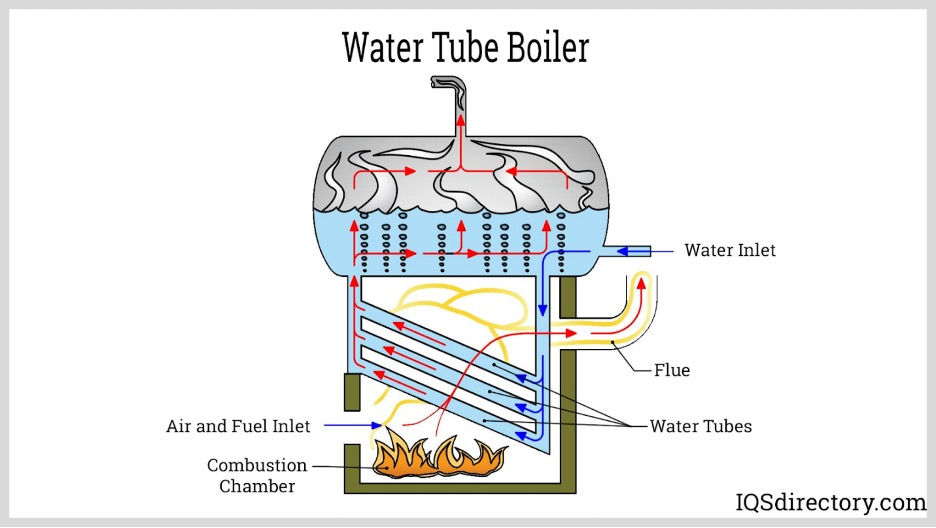
Watertube boilers reverse the heat exchange process.
Instead of hot gases traveling through tubes surrounded by water, water flows through tubes that are surrounded by hot combustion gases.
How It Works:
Water circulates through thin tubes.
Combustion gases surround the tubes.
Heat rapidly transfers into the water.
Steam is generated and separated.
Remaining water recirculates for additional passes.
Because watertube boilers use thinner tubes and provide greater surface area contact between water and heat, they can operate at:
Higher pressures
Higher temperatures
Faster response times
Advantages of Watertube Boilers:
Faster heat recovery and turndown capability
Higher efficiency
Greater steam output per hour
Better suited for industrial or large-scale applications
Watertube boilers are often preferred for heavy industrial operations and facilities requiring high-pressure steam production.
Considerations:
Higher upfront cost
More complex maintenance
More specialized operation requirements
Evolving Boiler Technology
Boiler technology continues to advance — especially as sustainability and efficiency become industry priorities.
Smart & AI-Enabled Boilers
Modern “smart” boilers integrate sensors that monitor:
Temperature
Pressure
Load demand
AI-powered controls can automatically adjust combustion rates to optimize efficiency and reduce energy waste. With continuous monitoring, boilers can respond dynamically to real-time building conditions.
The result:
Improved energy performance
Reduced heat loss
Lower operating costs
Greater reliability
Condensing Boiler Technology
Condensing boilers represent another major advancement.
Traditional boilers release combustion gases after heat transfer. Condensing boilers, however, capture latent heat from exhaust gases that would normally be wasted.
By recycling this energy:
Carbon emissions are reduced
Fuel consumption decreases
System efficiency increases
These systems are particularly effective in hydronic heating applications where lower return water temperatures allow for full condensation.
Sustainable Energy Integration
The future of boiler systems also includes alternative energy sources, such as:
Hydrogen-fueled systems
Biomass boilers
Solar-assisted heating
Geothermal steam systems
Modular boiler plants for flexible load management
These innovations reduce dependence on fossil fuels while improving overall system adaptability and sustainability.
Conclusion
Firetube and watertube boilers each offer unique advantages. The right choice depends on:
Application size
Required pressure and temperature
Maintenance capabilities
Budget
Long-term efficiency goals
Both technologies ultimately achieve the same outcome — reliable heating and steam production — but their operational characteristics make them suitable for different environments.
As boiler technology evolves, the greatest efficiency gains are now being found not only in mechanical design, but in smarter controls and cleaner energy integration.
When evaluating your next boiler system, consider both traditional design factors and emerging technologies that support sustainability and long-term operational performance.
For more information on steam boiler solutions, contact Northrich Co. at 216-581-4750 or visit www.northrich.com.


Comments